Launch offer — valid today only

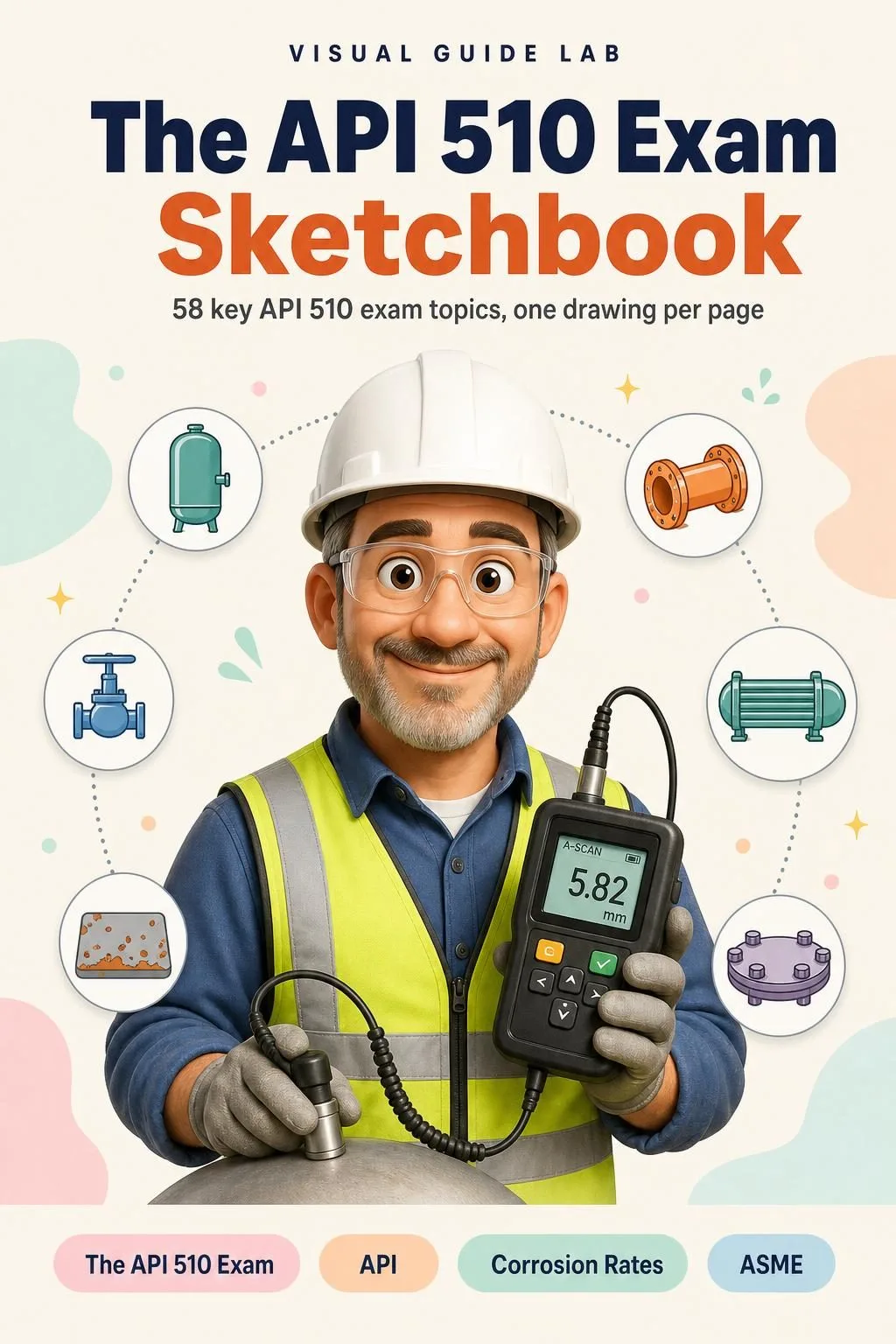
API 510 Exam: Every Calculation in the Same Order One topic per page, drawn, with where to look in the open-book PDFs

Which R goes into UG-27? Which E do you take? Which document do you open in the open-book portion? Here each API 510 topic fits on one page: the drawing, the calculation in fixed steps, and a box that tells you where to look in your code PDFs. 62 illustrated pages.

SHOW ME THE DRAWN PAGES

🔒 Secure checkout · PDF by email · 30-day guarantee

One topic per pageOne topic per page, every calculation in the same steps
62 illustrated pages11 parts, from the API 510 exam to PMI
Up-to-date sourcesAPI 510 Body of Knowledge and the current API 510 Publications Effectivity Sheet

This Is What the Pages You Will Study Look Like

One topic per page, the drawing that shows you how it's done, and boxes with what you need to know:

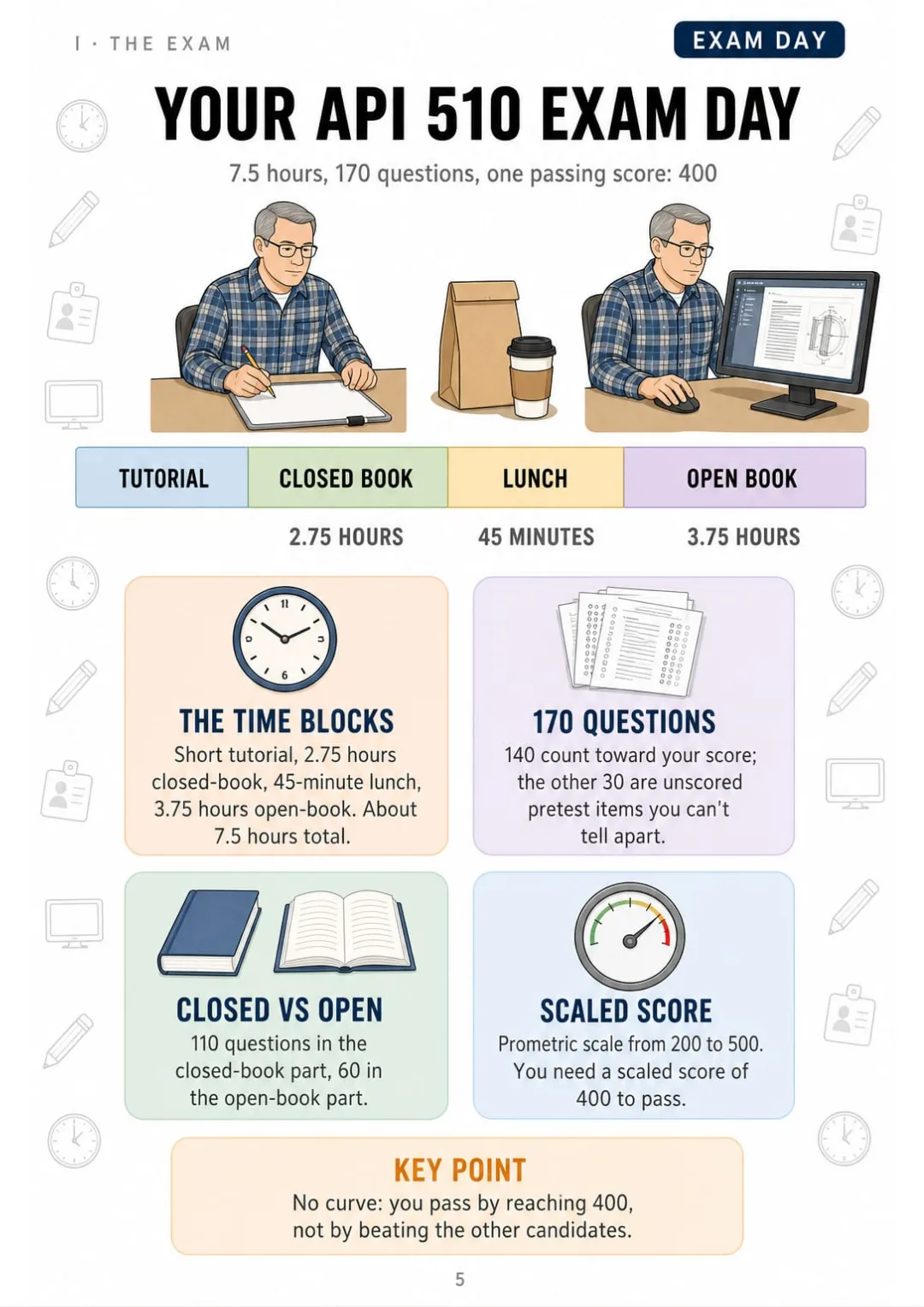
170 questions, 140 scored: 2.75 h closed-book + 3.75 h open-book, pass at 400 on a 200-500 scale
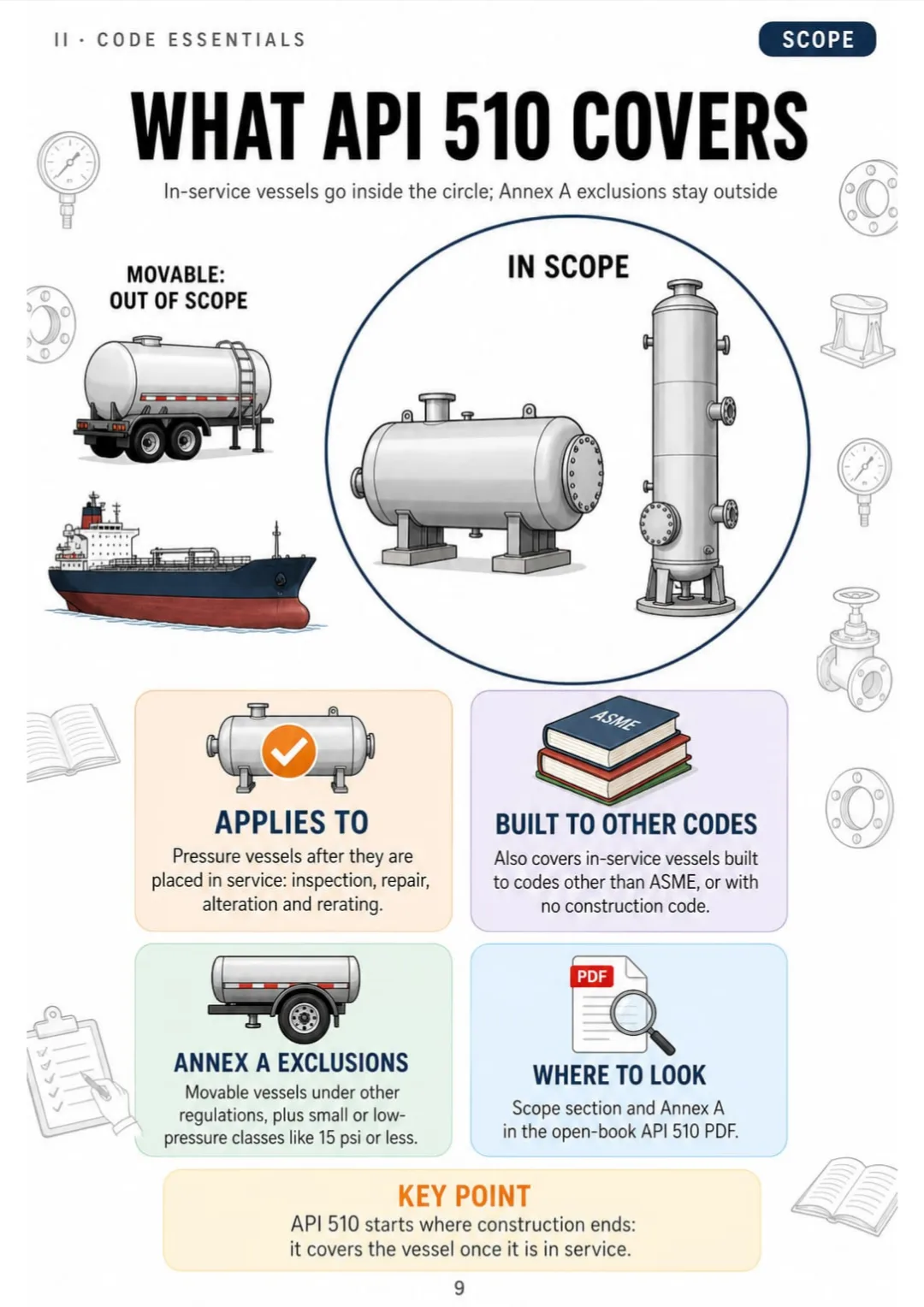
API 510 scope: in-service vessels inside the circle, Annex A exclusions outside
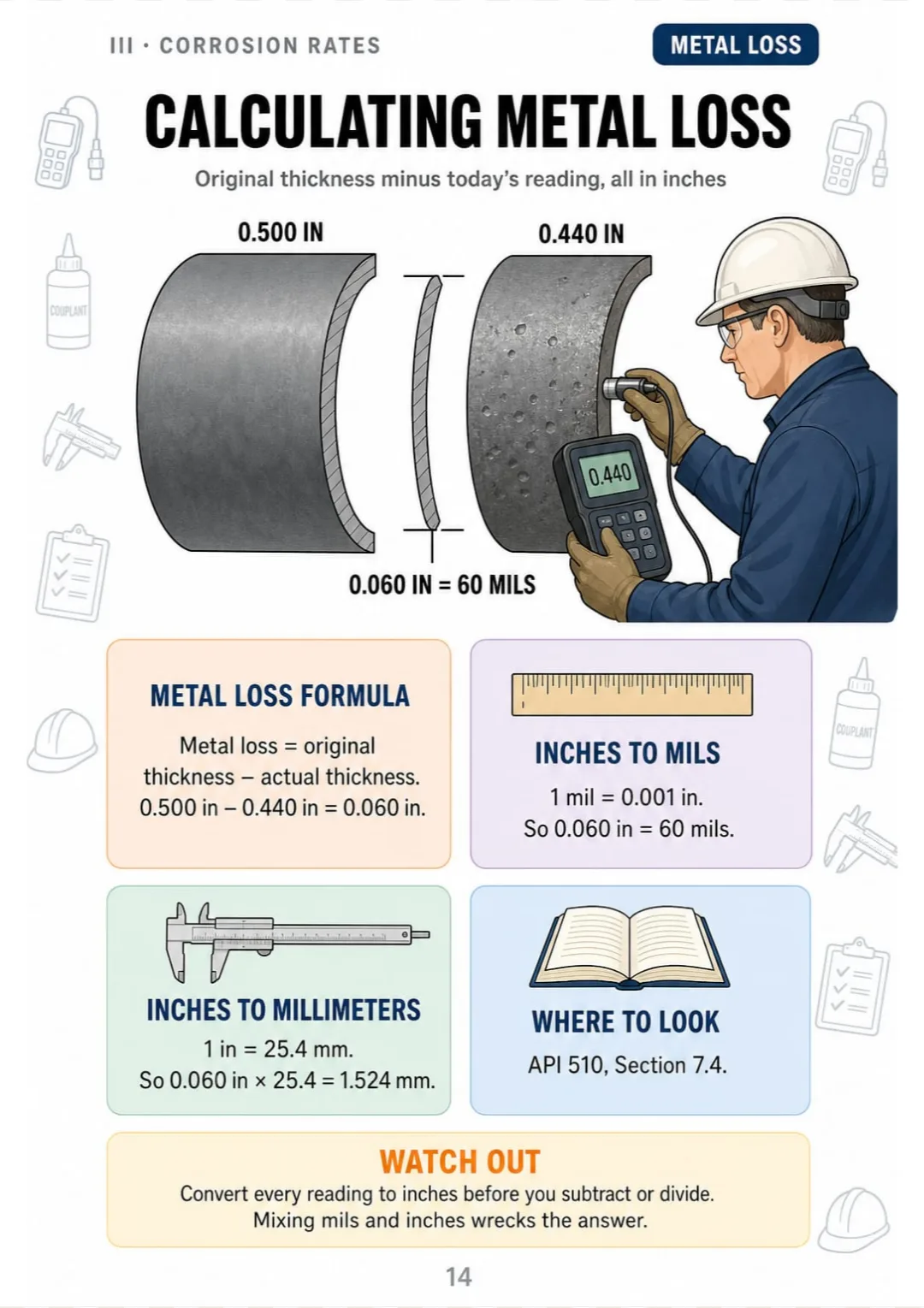
0.500 in − 0.440 in = 0.060 in of metal loss (60 mils, 1.524 mm).
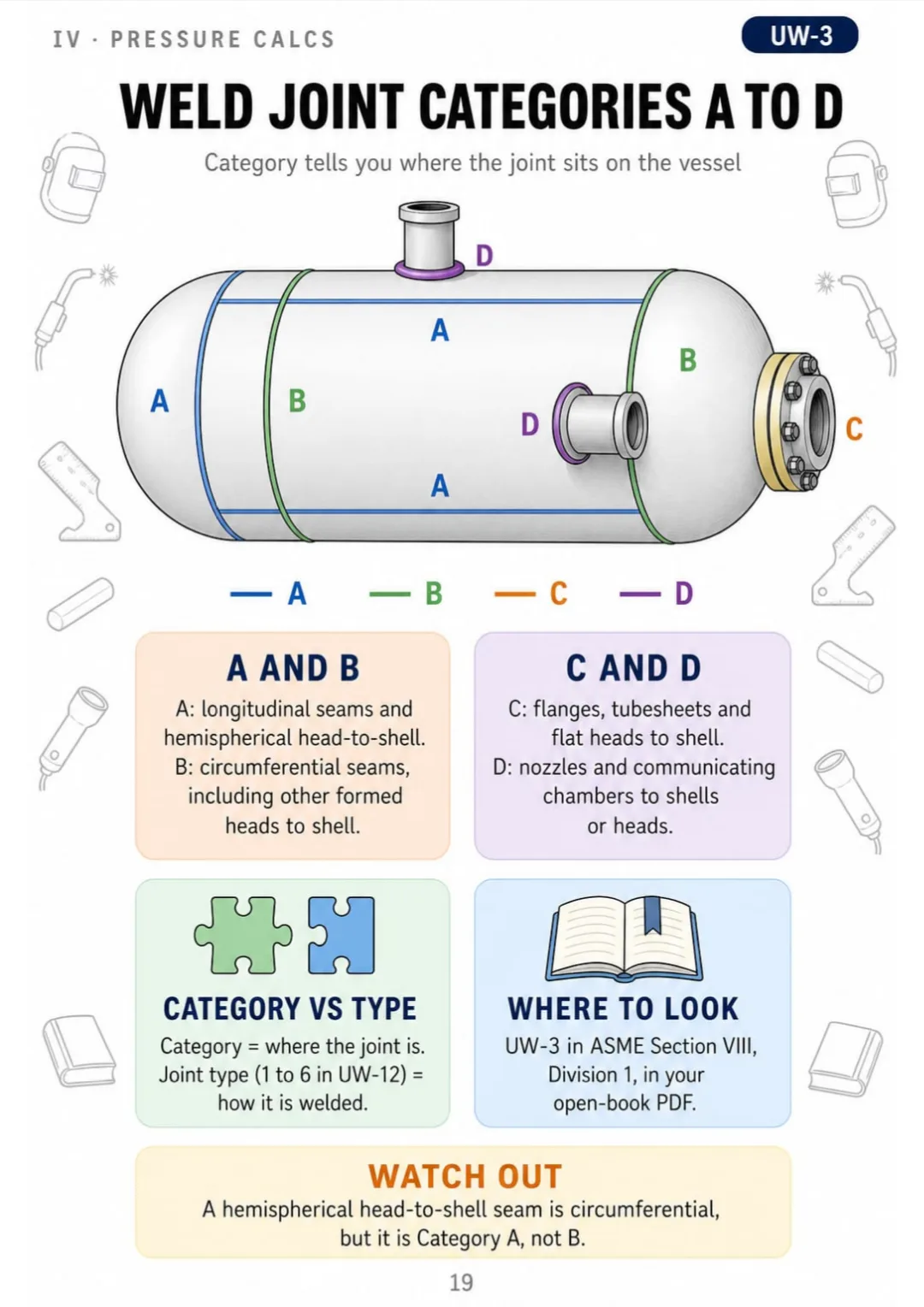
UW-3 on one vessel: A longitudinal, B circumferential, C flanges, D nozzles.
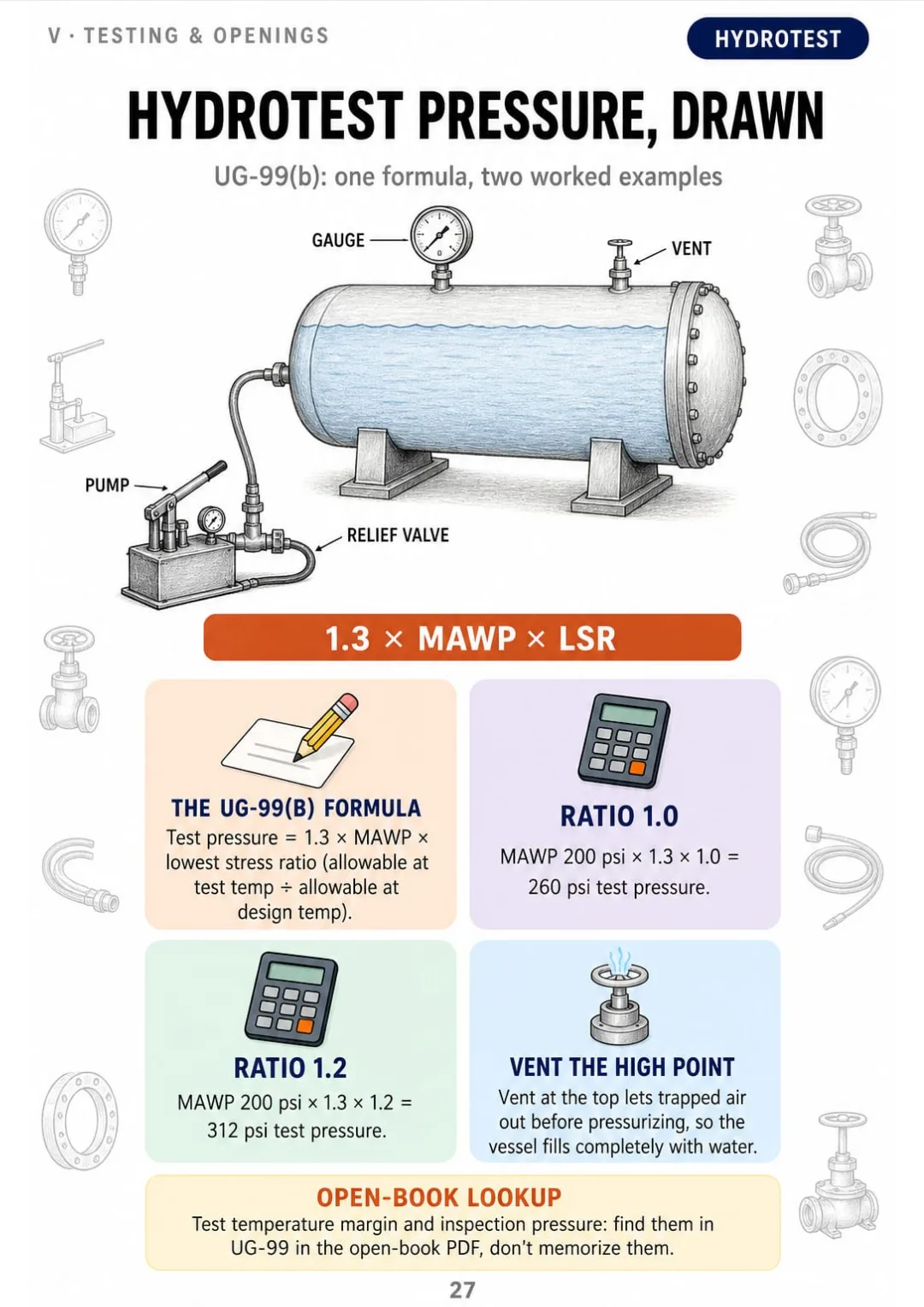
UG-99(b): MAWP 200 psi → 260 psi at ratio 1.0, 312 psi at ratio 1.2
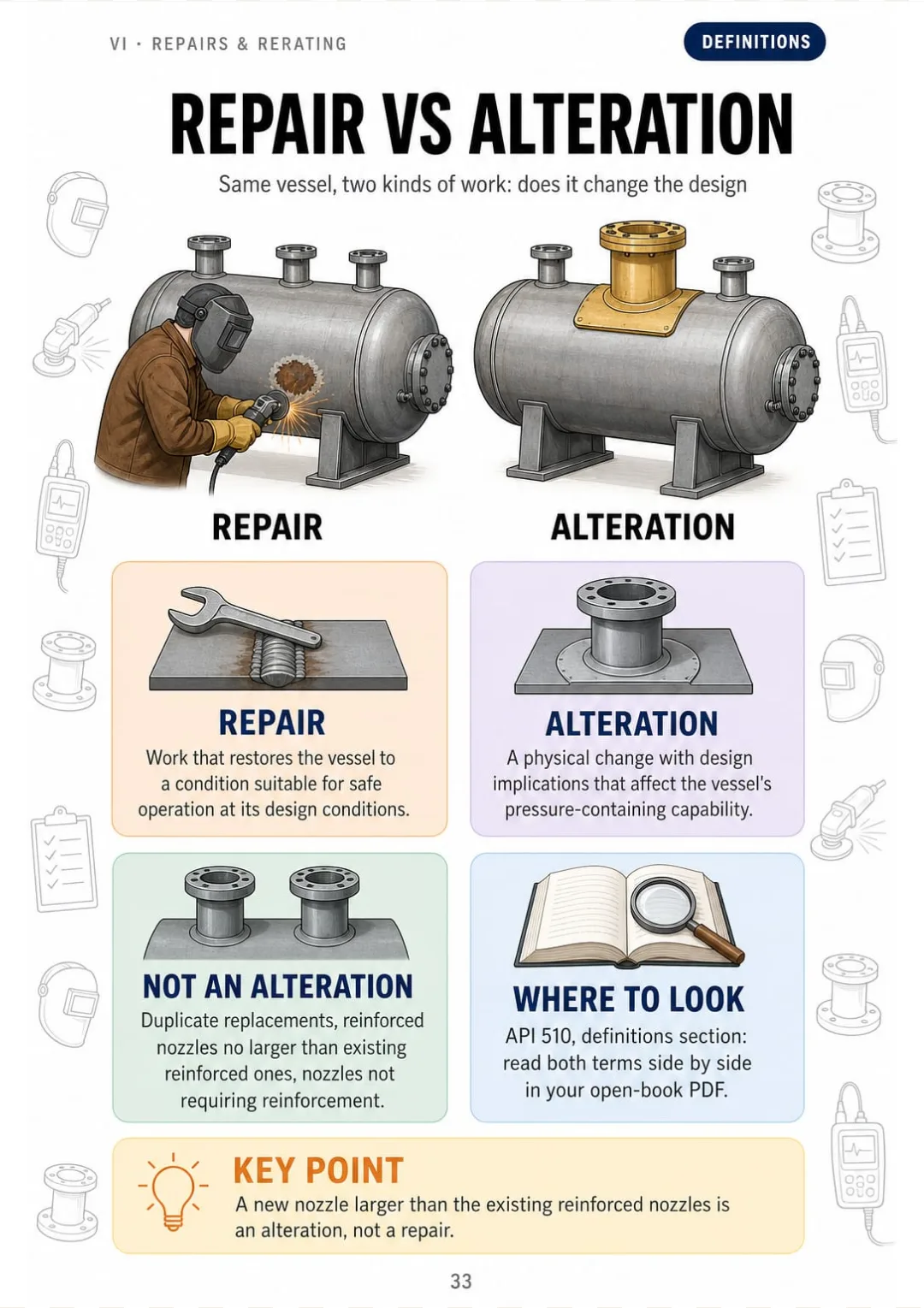
Repair restores; alteration changes design—like a nozzle larger than the existing ones.
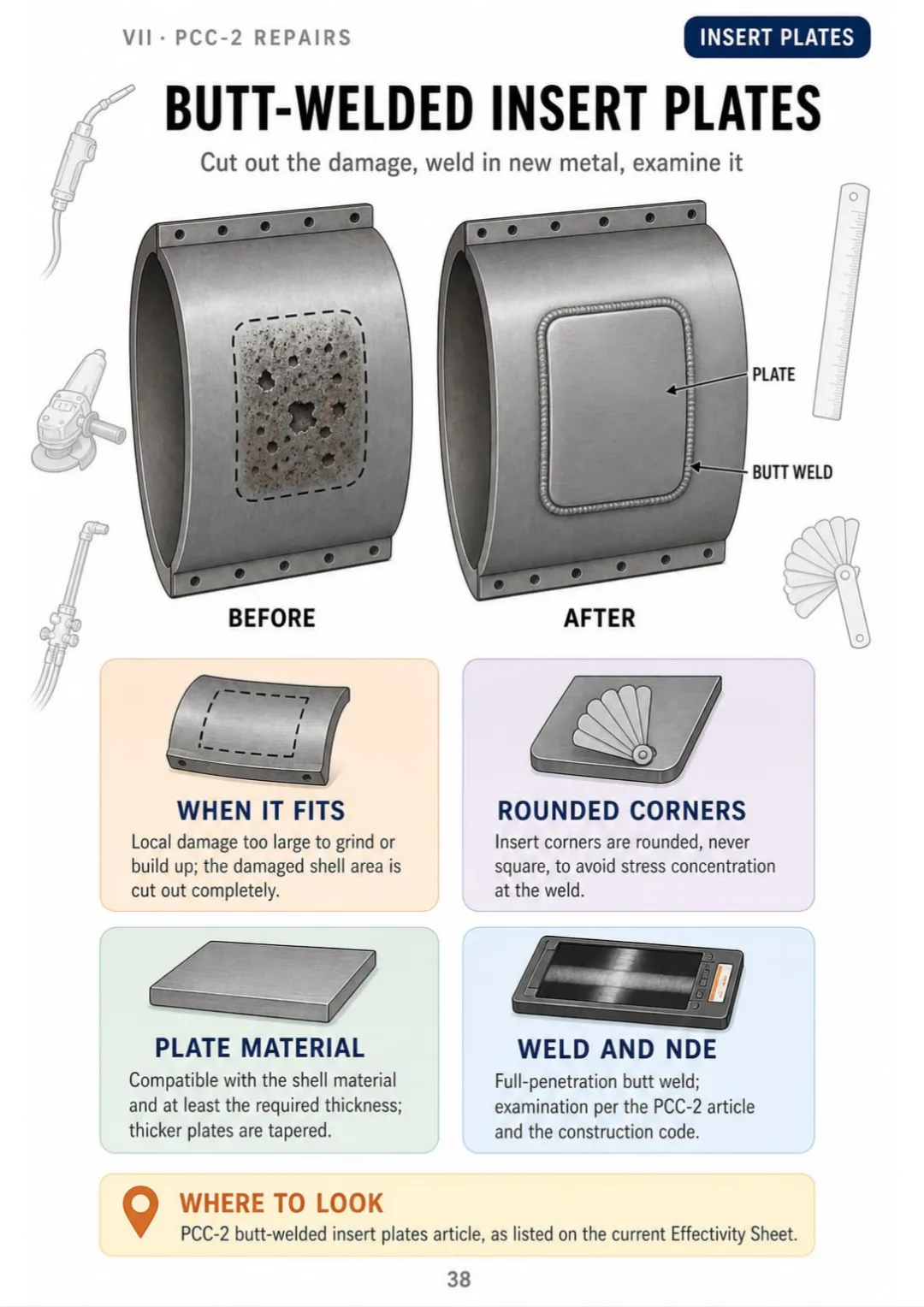
Insert plate: rounded corners, full-penetration butt weld, NDE per PCC-2
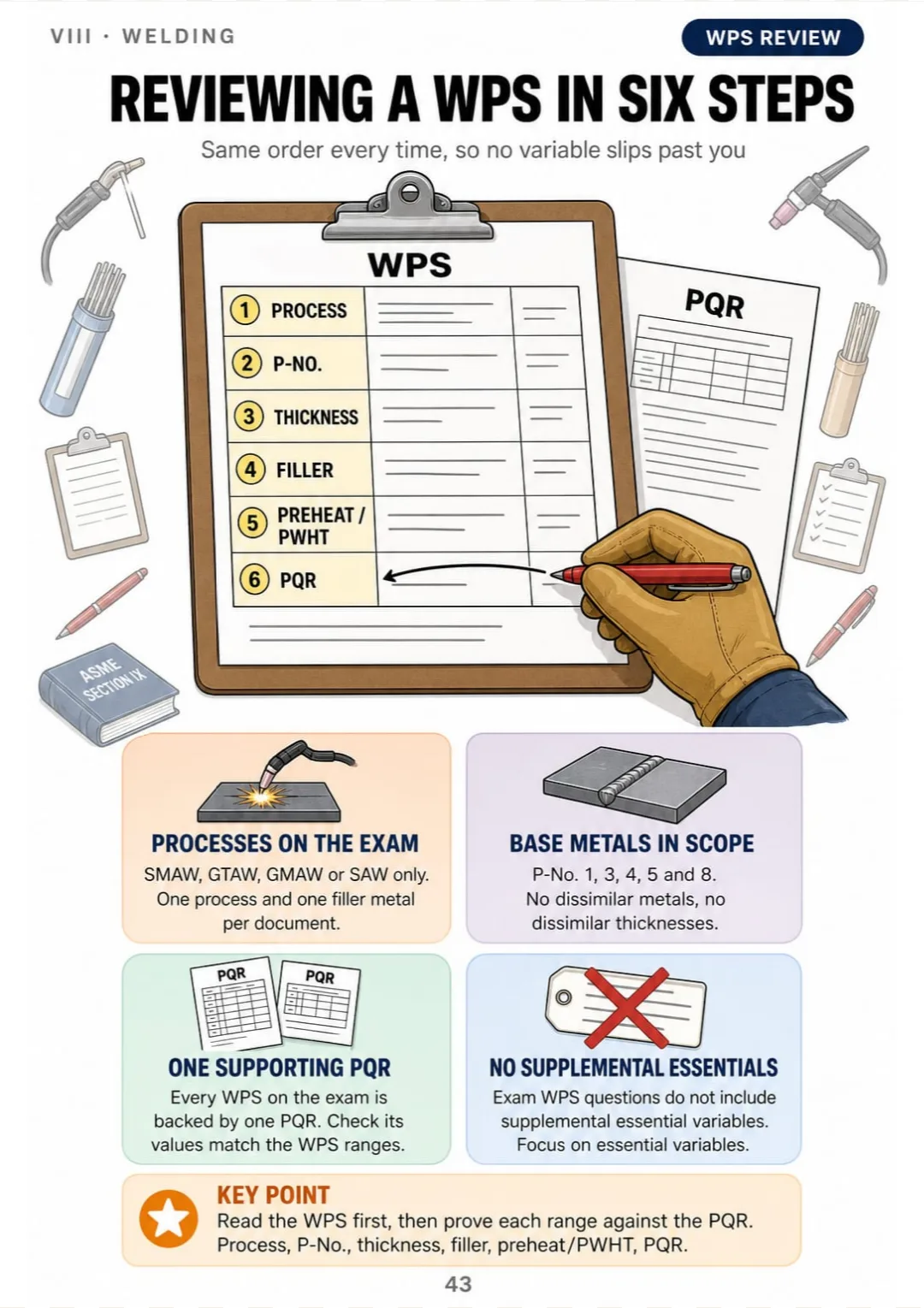
WPS review order: process, P-No., thickness, filler, preheat/PWHT, supporting PQR.

Swipe to see more →

These are real pages from the book. The table of contents is the full one: 11 parts and 58 topics.

Nobody Put It in Order for You.

You've read the metal loss section three times. You close your notes...

...and you're not sure anymore which reading comes off which, or where the mils come in. It was just lines of text.

0.500 in − 0.440 in = 0.060 in of metal loss (60 mils, 1.524 mm).

Here metal loss is one page, drawn on the shell wall: the previous reading, the current reading and 0.500 in − 0.440 in = 0.060 in, 60 mils gone.

And on the pages next to it, each calculation has its own: short-term and long-term corrosion rate, remaining corrosion allowance, remaining life and the inspection interval.

First you understand why it's done that way. Then the order sticks on its own.

SEE THE DIFFERENCE

Stop Memorizing Rules You Can't Picture:

THIS
  • Pages and pages of dense text
  • Code rules without a single drawing
  • On exam day, you don't know where to start
API 510 applies to the in-service inspection, repair, alteration and rerating activities for pressure vessels and the pressure-relieving devices protecting them, once the vessel has been placed in service. It is applicable to vessels built to an applicable construction code and may also be applied to other vessels where the owner/user so elects. Certain classes of equipment are excluded or optional, as specified in Annex A, which should be read together with the definitions section and any jurisdictional requirements that take precedence in a given location.
FOR THIS
  • Every rule drawn
  • One topic per page, with the rules in boxes
  • You remember it because you've seen it
API 510 scope: in-service vessels inside the circle, Annex A exclusions outside
CONTENTS

Take a Look at the 11 Parts and 58 Topics

The exam, API 510 essentials, corrosion rates and intervals, ASME VIII pressure calculations, testing and toughness, repairs and rerating, PCC-2 repair methods, welding, NDE, damage mechanisms and inspection practice: 62 pages, all drawn

IThe API 510 Exam · pp. 5-8
  1. What the API 510 Exam Covers
  2. Effectivity Sheet and Body of Knowledge
  3. Closed-Book vs Open-Book Strategy
  4. Eligibility, Fees and Recertification
IIAPI 510 Code Essentials · pp. 9-13
  1. Scope and Exclusions of API 510
  2. Key Definitions and Inspector Roles
  3. Inspection Plans and Risk-Based Inspection
  4. Internal, On-Stream and External Inspection
  5. Inspection Records and Reports
IIICorrosion Rates, Remaining Life and Intervals · pp. 14-18
  1. Calculating Metal Loss
  2. Short-Term and Long-Term Corrosion Rates
  3. Remaining Corrosion Allowance
  4. Remaining Service Life
  5. Setting Internal and External Intervals
IVASME VIII Div. 1 Pressure Calculations · pp. 19-26
  1. Weld Joint Categories (UW-3)
  2. Radiography Markings RT-1 to RT-4
  3. Joint Efficiency From Table UW-12
  4. Static Head Pressure on Vessel Parts
  5. Vessel MAWP vs Part MAWP
  6. Shell Required Thickness and MAWP
  7. Head Required Thickness and MAWP
  8. Handling Corrosion Allowance in Calculations
VPressure Testing, Toughness and Openings · pp. 27-32
  1. Hydrostatic Test Pressure and Temperature
  2. Pneumatic Testing and Precautions
  3. Impact Testing Requirements (UG-84)
  4. MDMT and Impact Test Exemptions
  5. Weld Sizes at Openings (UW-16)
  6. Nozzle Reinforcement Concepts
VIRepairs, Alterations and Rerating · pp. 33-37
  1. Repair vs Alteration
  2. Authorization and Approval of Repairs
  3. Repair Welding and PWHT Alternatives
  4. Pressure Testing After Repairs
  5. Rerating and Nameplate Stamping
VIIASME PCC-2 Repair Methods · pp. 38-42
  1. Butt-Welded Insert Plates
  2. External Weld Buildup for Thinning
  3. Fillet Welded Patches
  4. Hot Taps and In-Service Welding
  5. NDE in Lieu of Pressure Testing
VIIIWelding: ASME IX and RP 577 · pp. 43-47
  1. Reviewing a WPS
  2. PQR Mechanical Tests and Acceptance
  3. Welder Performance Qualification (WPQ)
  4. Welding Processes and Discontinuities
  5. Welding Metallurgy and Heat Treatment
IXNDE: ASME Section V · pp. 48-52
  1. Article 1 General Requirements
  2. Radiography and IQI Selection
  3. Liquid Penetrant Examination
  4. Magnetic Particle Yoke and Prod
  5. SE-797 Ultrasonic Thickness Measurement
XDamage Mechanisms (RP 571) · pp. 53-58
  1. Brittle Fracture
  2. Amine, Caustic and Chloride Cracking
  3. Wet H2S Damage
  4. High-Temperature Hydrogen and Sulfidation
  5. Corrosion Under Insulation and Atmospheric
  6. Acid Corrosion and Erosion
XIInspection Practice, Relief Devices and PMI · pp. 59-62
  1. RP 572 Vessel Inspection Practices
  2. Pressure-Relief Device Types (RP 576)
  3. Relief Device Inspection and Testing
  4. Material Verification and PMI (RP 578)

What If Every Topic Fit on a Single Page?

Imagine this:

Instead of rereading half a page about the UW-3 joint categories without being able to picture them...

...you open the page and find one vessel with every weld marked: A longitudinal, B circumferential, C flanges, D nozzles.

UG-99(b): MAWP 200 psi → 260 psi at ratio 1.0, 312 psi at ratio 1.2

And corrosion rates, remaining life, hydrotest pressure, repairs and WPS review turn into drawings and tables you can read at a glance.

You stop repeating and start understanding.

That's what The API 510 Exam Sketchbook does: 62 drawn pages in 11 parts, 58 exam topics, one per page, and every topic page tells you where to look in the open-book PDFs. You see it in order, so you can redo it in order.

Because what your brain sees organized, it remembers.

Here Is What You Get with The API 510 Exam Sketchbook:

Ipp. 5-8

The API 510 Exam

What the exam covers, the Effectivity Sheet and Body of Knowledge, closed-book vs open-book strategy, eligibility, fees and recertification.

IIpp. 9-13

API 510 Code Essentials

Scope and exclusions, key definitions and who does what, inspection plans and RBI, internal, on-stream and external inspection, records and reports.

IIIpp. 14-18

Corrosion Rates, Remaining Life and Intervals

From two UT readings to the next inspection date, in the same steps every time: metal loss, short-term and long-term rate, remaining corrosion allowance, remaining life and the internal and external interval.

IVpp. 19-26

ASME VIII Div. 1 Pressure Calculations

See every weld on one vessel, A to D, and know which RT level and joint efficiency it takes. Then shell and head thickness, static head, vessel vs part MAWP and where corrosion allowance goes.

Vpp. 27-32

Pressure Testing, Toughness and Openings

Hydrostatic and pneumatic test pressure, impact testing, MDMT and exemptions, weld sizes at openings and nozzle reinforcement.

VIpp. 33-37

Repairs, Alterations and Rerating

Repair vs alteration, who authorizes and approves, repair welding and PWHT alternatives, testing after repairs, rerating and the nameplate.

VIIpp. 38-42

ASME PCC-2 Repair Methods

Insert plates, external weld buildup, fillet welded patches, hot taps and in-service welding, and NDE in lieu of pressure testing.

VIIIpp. 43-47

Welding: ASME IX and RP 577

Reviewing a WPS, PQR tests and acceptance, welder qualification, processes and discontinuities, metallurgy and heat treatment.

IXpp. 48-52

NDE: ASME Section V

Article 1 general requirements, radiography and IQI selection, liquid penetrant, magnetic particle yoke and prod, and UT thickness per SE-797.

Xpp. 53-58

Damage Mechanisms (RP 571)

Brittle fracture, amine, caustic and chloride cracking, wet H2S, high-temperature hydrogen and sulfidation, CUI and atmospheric corrosion, acid corrosion and erosion.

XIpp. 59-62

Inspection Practice, Relief Devices and PMI

RP 572 vessel inspection practices, relief device types, relief device inspection and testing, and material verification with PMI.

At the end of the book: A 'where to look' box on every page, pointing to the paragraph in your open-book PDFs.
And That Is Not All: 2 More Books, Free

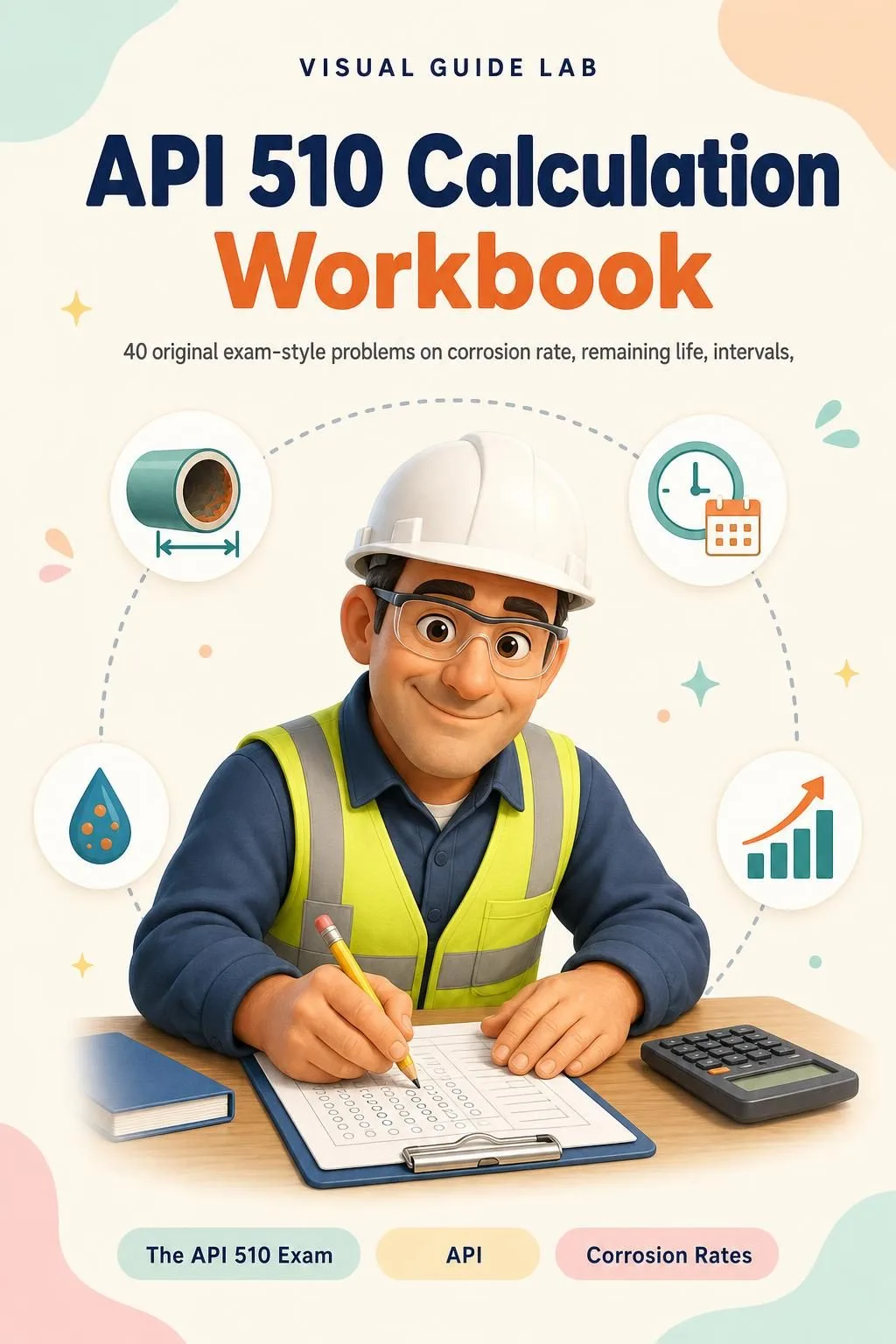
API 510 Calculation Workbook

BONUS 1: «API 510 Calculation Workbook»

Value on its own: US$ 17.90

40 original exam-style problems on corrosion rate, remaining life, intervals, shell and head thickness, MAWP, static head and test pressure, each one worked step by step, so you practice the math until it comes out in the same order every time.

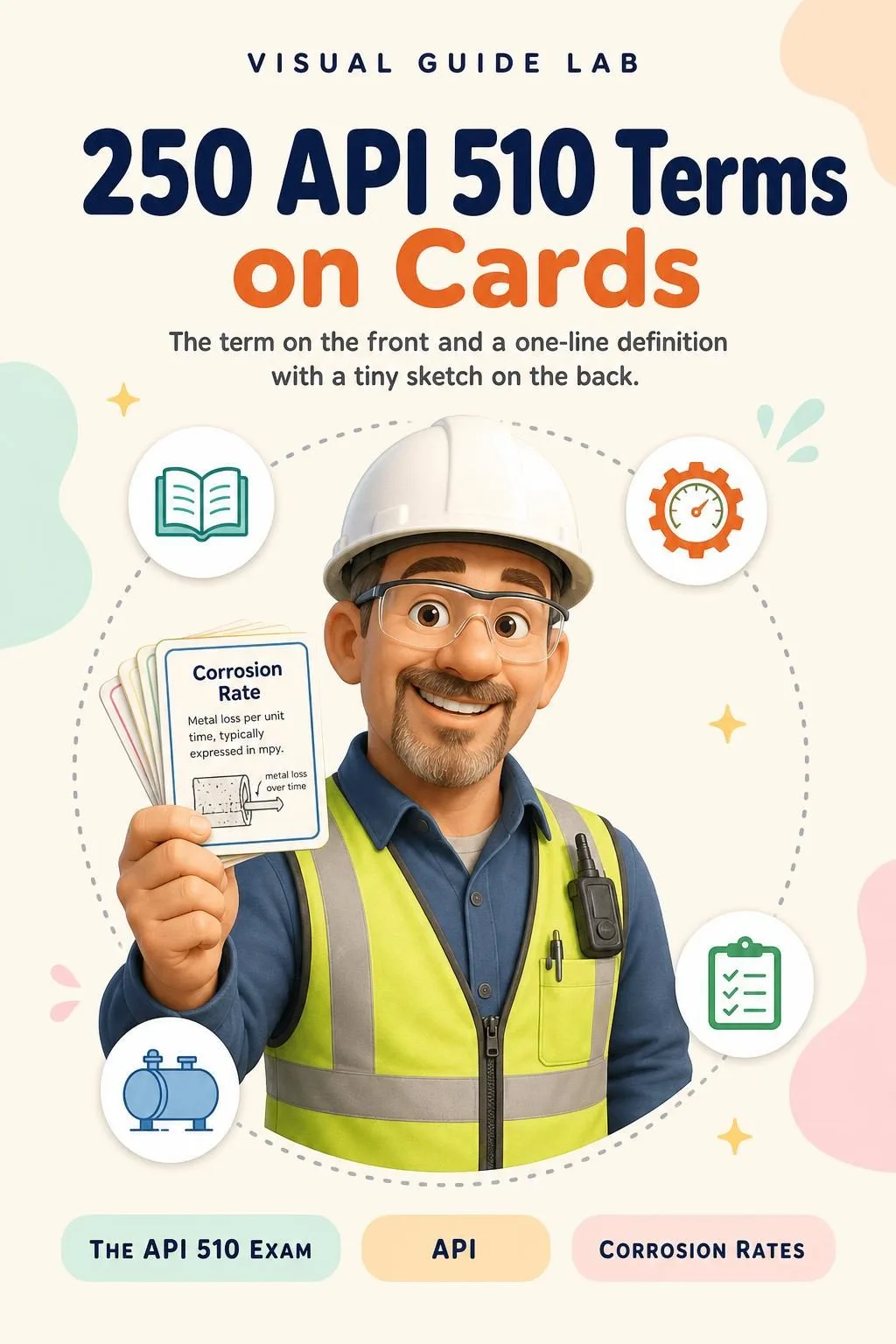
250 API 510 Terms on Cards

BONUS 2: «250 API 510 Terms on Cards»

Value on its own: US$ 14.90

The term on the front and a one-line definition with a tiny sketch on the back. Print them and go over the vocabulary in short breaks between shifts.

The API 510 Exam Sketchbook + 2 Free Books

  • The API 510 Exam Sketchbook: 62 illustrated pagesUS$ 87
  • BONUS 1: API 510 Calculation WorkbookUS$ 17.90
  • BONUS 2: 250 API 510 Terms on CardsUS$ 14.90
  • High-resolution PDF to printIncluded
Total value US$ 119.80
YOUR PRICE:
US$ 37
You save US$ 82.80
YES, I WANT THE API 510 EXAM SKETCHBOOK FOR US$ 37

📄 This is a digital PDF book sent to your email: nothing is printed or shipped.

Secure purchaseEncrypted payment30-day guarantee

PDF by email: The API 510 Exam Sketchbook reaches your inbox as a PDF, and the two free books come by email too. One-time payment, no installments or hidden costs.

Is This Book for You?

You're moving from NDE or QA/QC into inspection

You're moving from NDE or QA/QC into inspection

You take UT readings and look at welds every day. Here you see the code side of that work, one drawn page at a time: thickness, MAWP, joint categories, WPS review.

Your API 510 exam window is coming up, or you're retaking it

Your API 510 exam window is coming up, or you're retaking it

The whole Body of Knowledge in order, every calculation in the same fixed steps, and a 'where to look' box on each page for the open-book portion.

You already work as an inspector

You already work as an inspector

A quick drawn review of what you see in the plant: hydrotests, repair vs alteration, PCC-2 repair methods and the RP 571 damage mechanisms on the sheet.

To Sum Up: Here Is What You Get

US$ 119.80US$ 37
YES, I WANT THE API 510 EXAM SKETCHBOOK FOR US$ 37

📄 This is a digital PDF book sent to your email: nothing is printed or shipped.

30DAYS
GUARANTEE

30-Day Guarantee

30-day guarantee: tell us what didn't work and we'll refund 100%.

You have 30 days to try The API 510 Exam Sketchbook and the two free books. If it doesn't work for you, tell us what didn't work and we'll refund 100% of what you paid. One-time payment, no subscription.

Frequently Asked Questions

How do I receive the material?

The API 510 Exam Sketchbook comes as a high-resolution PDF by email, sent to the address you enter at checkout, to read on your phone, tablet or computer, or to print. The two free books, API 510 Calculation Workbook and 250 API 510 Terms on Cards, also come by email.

Is it a monthly or a one-time payment?

A one-time payment of US$ 37. No installments and no subscription.

Who is it for?

For anyone preparing for the API 510 Pressure Vessel Inspector exam: in-service inspectors, NDE and QA/QC technicians moving into vessel inspection, and anyone retaking it. It's not a beginner's book about what a vessel is, and it covers API 510 only, not API 570 or 653. Check the index above to see every topic.

What sources is it based on?

On the API 510 Body of Knowledge and the API 510 Publications Effectivity Sheet that API publishes for the current exam windows. Before you start, check on the API website which edition applies to your exam date. The book doesn't reproduce code text, tables or figures: each page points to the paragraph to look up in your own documents.

Is this official API material?

No. It's an independent study book, not affiliated with or endorsed by API, ASME or Prometric. It doesn't give a certificate or PDH credits: the API 510 certification only comes from passing the API exam.

Does it replace the codes or a prep course?

No. For the open-book portion you still need the code documents listed on the Effectivity Sheet. It doesn't replace a prep course, your company's procedures or a qualified inspector's judgment: it's a clearer way to review.

Are the practice problems the ones on the exam?

No. The 40 problems in the Calculation Workbook are written for this book. They aren't official API 510 exam questions; they're there so you practice the method.

Can I print it?

Yes. The PDF is high resolution, so you can print the whole book or only the parts you want to keep on hand. The 250 Terms on Cards are made to be printed.

What if I don't like it?

30-day guarantee: tell us what didn't work and we'll refund 100%.

One Last Thing Before You Decide...

You don't have to reread the same page hoping it sticks this time.

You don't have to memorize formulas you can't picture.

And you definitely don't have to walk into the exam not knowing where to start.

One last thing before you decide: you already have the code PDFs and the notes. What was missing is the order. 62 drawn pages, a “where to look” box on every one, and 2 free books to practice and review.

One-time payment: US$ 37 · Guarantee: 30 days · PDF by email

YES, I WANT THE API 510 EXAM SKETCHBOOK FOR US$ 37

📄 This is a digital PDF book sent to your email: nothing is printed or shipped.